Archive for the ‘death’ Category
Outside the Sanctuary
On April 27, 1959, my grandmother Wilkerson died.
I traveled with my parents to a church in Snellville, Georgia. I was not admitted into the building. I remained in the car — a black Ford coupe — parked on gravel beneath open windows.
This was the second death of my childhood. My grandfather Powell had died in July of 1957. I remember more of him. He was sixty-four. She was eighty-six. I was too young to understand death’s permanence, but I felt his absence. I also felt, without language for it, the fracture between him and my mother, and her refusal of affection toward the woman who became his companion after divorce. Even as a child, I sensed something torn.
But my grandmother Wilkerson’s death was different.
It was my first existential crisis.
From the sanctuary, across the gravel parking lot and through the open windows of that black coupe, a hymn drifted toward me:
Rock of Ages, cleft for me,
Let me hide myself in Thee;
Let the water and the blood,
From Thy riven side which flowed,
Be of sin the double cure,
Cleanse me from its guilt and power.
In films, that hymn is often reduced to shorthand for naïveté — a prop for simplistic faith. But it was nothing of the sort to me.
I was a boy sitting outside a church, trying to locate my grandmother inside those words.
Where is she?
And by extension — where is he?
That question has never left me.
Now, more than sixty years later, I sit in church again. It is Lent. Deaths have layered themselves over time, one pressing upon another. Each carries weight.
But there is one whose weight eclipses the rest.
Beth.
Her absence is not historical. It is immediate. It still crushes me.
The boy in the black Ford coupe asked, Where is she? about his grandmother.
The man in the pew asks the same question now.
Where is she?
I weep for her.
And yet, in ways I do not fully understand, I sometimes experience her not as memory alone but as presence. Not as an “It” confined to the past, but as Thou — to borrow Buber’s language — encountered in moments that are unsummoned and enlarging.
I fear wishful thinking. There were long years — decades — of silence. I know what absence feels like. This renewed sense of nearness feels fragile.
But here is what steadies me:
When I sense her presence, I do not become smaller or more withdrawn. I become more loving.
If it were fantasy, I suspect it would narrow me. Instead, it opens me — toward patience, toward tenderness, toward others.
If love reduces the dead to memory alone, then death wins twice.
I am not ready to grant it that victory.
The boy is still listening through open windows.
And even now, I think I hear the hymn.
The Uninvited Day
Some days arrive uninvited. They just happen.
Bags are packed—sometimes decades earlier—then stowed away, waiting. Waiting for the uninvited day. When it comes, the bags tumble out of their hiding places, and the contents explode into life.
Yesterday was such a day.
I had an appointment at a medical office dealing with a disease no one wishes to face. It was, in itself, rather matter-of-fact: identify the disease, consider treatment options, make decisions, do my part as a credible member of the team seeking to eradicate the problem.
But then came the baggage.
The baggage carries the awareness of mortality—not so much my own, but of those I’ve loved. Sitting in the doctor’s office, I was reminded again of how many times my late wife must have had similar conversations. Her cycle of remission and relapse always included consultations like this: the tests, the scans, the waiting for results. I was there for much of it.
Those suitcases have been familiar companions for many years.
But yesterday I unpacked another one I didn’t expect: the one I now call Morbid Math.
Morbid Math began when the doctor alluded to my advanced age, as if age alone dictates outlook. Yes, the older we get, the more we must face our finitude. But as I told him, anyone—at any age—can drop dead in a moment. Statistics may predict probability, but statistics don’t govern individuality.
This is where the science of medicine must, if practiced well, meet the art of medicine. Options may narrow with age, but every life still deserves case-by-case care.
And that’s when the arithmetic began.
In just a few years, I will have lived twice as many years as my late wife. That realization stung. I could have done without it. But the uninvited day doesn’t ask permission to unpack what it brings.
Then came another calculation. I remarried thirty-one years ago this past August. Counting the years of our courtship, Beth and I were together twenty-two years—nineteen of them married. The sheer ratio of years makes comparisons absurd. Yet I know this: Beth and I grew up together, and Lucy and I are growing down together. Each love has its own trajectory.
The problem is that growing up was interrupted. And so, I’ve spent the years since trying, in some way, to complete the work Beth and I began. I got to watch our daughters grow up. She did not.
Thank you, Morbid Math, for that reminder.
Two lifetimes, divided unevenly, yet both defining who I am. Beth didn’t just influence me—she created part of me. But she never saw the whole. In that sense, the sum is zero.
She never saw me in my entirety. I robbed her of that.
I know, unequivocally, that she would have. We were on a trajectory toward that kind of honesty. We even talked about the changes we would make to become more fully ourselves—individually and together. But the equation ended before it could balance.
So yes, yesterday was the uninvited day.
One of the worst I’ve had since the day she died.
But even this arithmetic of loss holds its strange grace: that who I have finally become—the man willing to be raw and vulnerable—is the collaborative work of two women who loved me into wholeness.
Beth began the work. Lucy has helped me finish it.
*I cannot change the sums, but I can live them. And perhaps that, in the end, is
Where All Waters Join
Sometimes grief does not cry out—it drifts, carried by the same current that once bore our joy.
There are moments when loss comes not as thunder but as reflection—when the world stands still, and what we see is not the end but a continuation, changed in form.
I wrote this after a dream of a river and a face that was both Ophelia’s and hers—the one I loved more than life itself.
It is not about death, not really. It’s about arrival: the mystery of the one who was, the one who is, and the one who has yet to come.
I offer it here in gratitude and quiet wonder, a meditation on how love endures beyond the reach of hands.
⸻
I see Ophelia floating, dreamlike,
on the current of a cold river.
The water moves with a whispering insistence,
brushing against stones polished by centuries of sorrow.
Her body is already still,
her face molded by the mercy of the chill
into a child’s perpetual smile.
Then the surface wavers,
and I recognize the curve of her mouth—
not Shakespeare’s daughter of grief,
but the woman I loved more than life itself.
The recognition is the wound.
Not that she is gone,
but that I can no longer feel the warmth
that once made her real.
The ache lives in my hands,
in what they remember
and the water refuses to return.
Yet even as I kneel on the bank,
a strange peace rises.
The river does not end;
it only carries her beyond my reach.
In its mirrored flow I see three arrivals:
the one who was — radiant and laughing in sunlight;
the one who is — still, luminous, beyond decay;
and the one who is yet to come —
the presence that will meet me when my own current slows.
I do not call it faith,
only recognition —
that love does not vanish;
it merely changes address.
The current carries her onward,
and somewhere downstream,
in water not yet visible,
I believe she waits —
not to return,
but to receive.
⸻
And so I let the river keep her, trusting that love, like water, knows its way home.
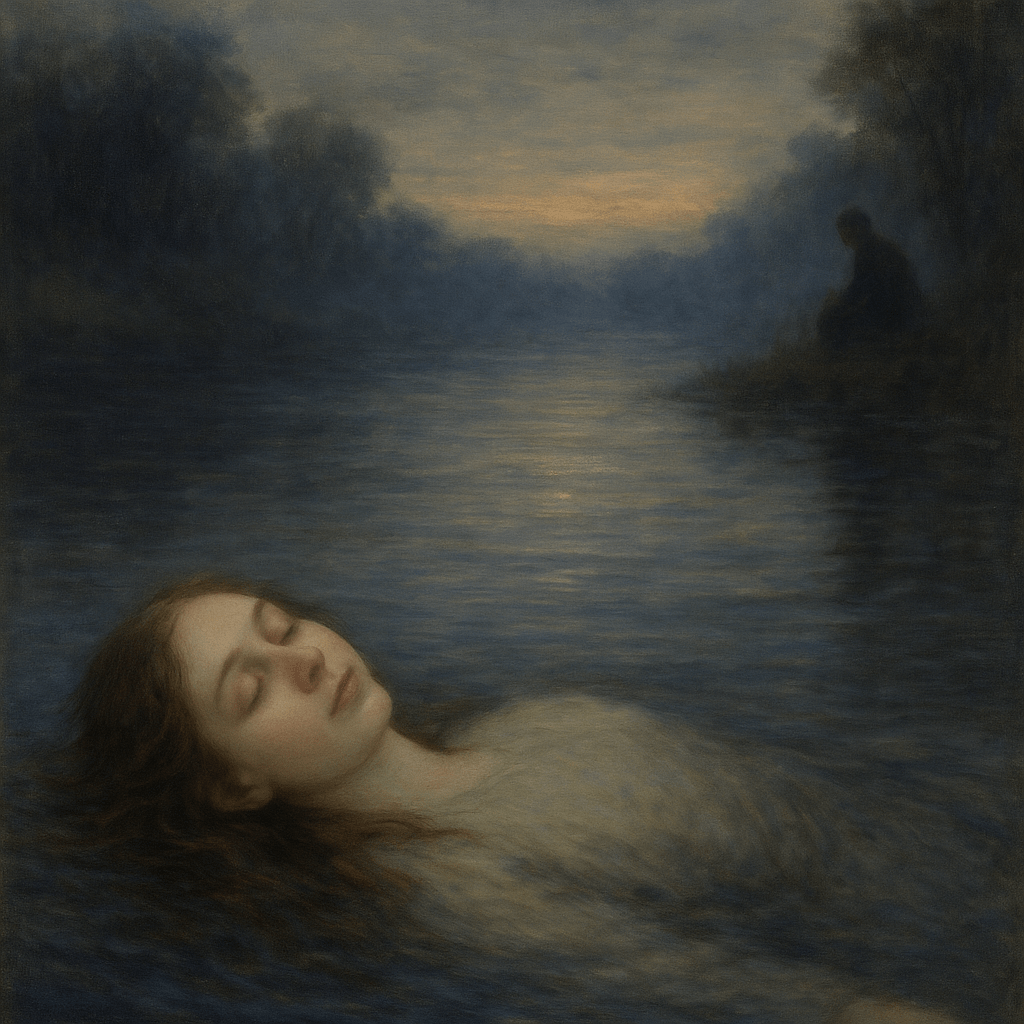
A lyrical reflection on loss and arrival. Through the image of a woman floating on a twilight river, “Where All Waters Join” explores how love endures beyond separation, and how grief, carried by the current, can become peace.
God in the Silence
There are silences that wound. The silence between two people who no longer know how to speak to one another. The silence after a loss so great that words cannot carry its weight. The silence of God, or what feels like God’s absence, when prayer becomes little more than breath.
.
I have lived with such silence. I thought it safer than speech, thought it might protect others from the depth of my sorrow. But silence has its own cost. It isolates. It hardens. It makes a person a stranger even to those who love them most.
.
And yet, in Romans Paul dares to say that even silence can be prayer. “The Spirit himself intercedes for us with groans too deep for words.” Which means that what I cannot say, God still hears. What I withhold, God still knows. What weighs me down with unspeakable grief, God lifts up and carries into the very heart of heaven.
.
This is a mystery. That the silence which feels like absence may, in truth, be full of God’s presence. That the groan we never utter may already be on the Spirit’s lips. That even when our mouths are closed, intimacy remains possible.
.
And perhaps this is our calling as servants of Christ—
not always to speak, not always to fix,
but sometimes simply to sit in the quiet with those who cannot speak.
To believe on their behalf.
To let silence be enough.
.
Because in the silence, God is already there.
.

Into Your Embrace
For thirty-two years
I kept the secret of my grief.
Poems unwritten,
words withheld,
a silence so heavy
it bricked the walls of our life.
.
For you,
who bore my silence
as I bore my sorrow,
you waited beside me,
through winters of hush,
through the long dark.
.
Now I write—
a voice for the dead,
and a voice for you,
the living beside me.
.
You said,
I would have loved them.
And whispered,
When I am gone,
will you remember me?
Your words cut me open
like a blade through cloth.
.
Who will deliver me?
Who will raise me
from the fall,
the fall of my silence?
.
For you,
who bore my silence
as I bore my sorrow,
let me lean,
let me lean into your embrace.
.
Let me breathe out dust and ashes,
the silence I have carried like stone.
Let me breathe in the fire of your breath,
the wine of your love,
the warmth of your body beside me.
.
For you,
for you,
for you—
into your embrace.
 On a whim...