Archive for the ‘hope’ Category
Unless I Touch
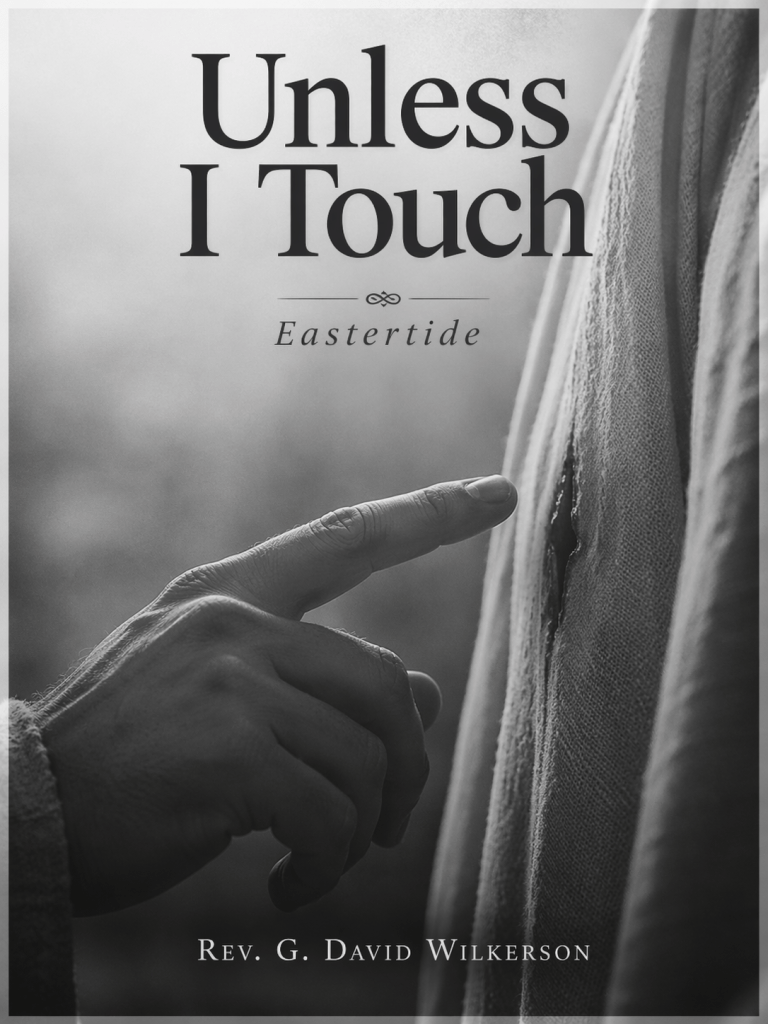
John 20:27 NRSV
“Put your finger here and see my hands. Reach out your hand and put it in my side. Do not doubt but believe.”
⸻
Thomas is not there the first time.
He misses the moment the others describe—the presence, the voice, the showing of hands. By the time he hears it, it has already become testimony. Something reported. Something he is expected to accept.
He does not.
Unless I see… unless I touch…
It sounds like doubt.
It is something else.
Thomas refuses to say more than he can sustain as true. He will not borrow certainty from someone else’s experience. If this is real, it must be real in a way he can trust.
I understand that instinct.
I cannot insist that I feel her presence. It does not come when I ask for it. It does not remain when I try to hold it. Most mornings, I weep if I do not distract myself. That is what I can say with certainty.
And still, I cannot say she is gone.
Absence does not behave cleanly. It does not remain contained. Something in my experience resists that conclusion. Not enough to prove. Not enough to name. Enough that I cannot call it absence.
So I do not say that I know.
I say that I hold.
Thomas stands in a different place.
He will not hold what he has not encountered. He will not say that something is real until it meets him in a way he can trust.
And Jesus does not refuse him.
He does not correct him. He does not shame him for asking. He offers what Thomas requires.
Reach out your hand.
Touch.
The wounds remain.
Not erased. Not explained. Still present in the body that stands before him.
And Thomas answers.
My Lord and my God.
We often hear what comes next as a correction.
Blessed are those who have not seen and yet have come to believe.
But it may not be a rebuke.
It may be a description.
There are those who encounter and those who are asked to live without that kind of certainty. Those who are given something they can touch, and those who must remain inside something they cannot hold.
I find myself there.
Not seeing.
Not touching.
Not able to insist.
And yet, unable to say that nothing remains.
To live inside resurrection is not to feel presence consistently, or to prove it.
It is to discover that absence is no longer a sufficient explanation.
Thomas needed to touch in order to trust.
I am learning to trust what I cannot touch—and to admit how difficult that is.
God meets him in what he needs.
God meets me in what I cannot hold.
I do not yet know how both can be true.
But I will not reduce either one.
⸻
Prayer
God, meet me in what I can touch and in what I cannot, and give me the courage to remain without resolving either.
⸻
Do Not Hold On
John 20:17 NRSV
“Jesus said to her, ‘Do not hold on to me…”
⸻
She does not recognize him at first.
Not because he is hidden. Because grief has arranged the world in a way that leaves no room for anything else. She is looking for a body. Something that can be found, carried, returned.
She is still speaking when he interrupts her.
“Mary.”
Not an explanation. Not an argument.
Her name.
And in that moment, everything shifts.
Recognition does not come through sight. It comes through being addressed. Through hearing what only one voice can say in that way.
She turns toward him.
Not gradually. Not cautiously. All at once.
“Rabbouni.”
She reaches for him.
Of course she does.
Not to test what she sees. Not to prove it. To hold it. To keep it from being taken again. To close her hands around what has already been lost once.
And that is where he stops her.
Do not hold on to me.
Not a rejection. Not a withdrawal. A boundary.
What is now present cannot be held the way it once was.
Resurrection does not return things to their previous form. It is not resuscitation. It does not restore what was lost so that it can be kept again. It changes what it means for something to be real.
She is not being asked to let go because he is leaving.
She is being asked to let go because he is no longer confined to what she can grasp.
The garden is quiet.
No crowd. No explanation. No resolution offered.
Only presence.
She does not understand it.
She cannot hold it.
And still, she has encountered it.
We are often taught to look for clarity. For something that settles the moment, explains what has happened, secures what has been given.
But this moment refuses that.
She is recognized.
She responds.
She reaches.
And she is interrupted.
Not so that the moment can end—
but so that it can become something she cannot possess.
Silence would have left her alone.
Quiet allowed her to hear her name.
And what she heard was not something she could keep.
Only something she could receive.
⸻
Prayer
God, teach me to receive what is real, even when I cannot hold it.
They Were Afraid
Mark 16:8 NRSV
“So they went out and fled from the tomb, for terror and amazement had seized them; and they said nothing to anyone, for they were afraid.”
⸻
It ends there.
No appearance.
No explanation.
No resolution.
They run.
Not because they doubt what they have seen. Not because they have rejected it. Because something has happened that they do not yet know how to live inside.
The tomb is empty.
The body is gone.
The message has been given.
He is not here. He is going ahead of you.
And they are afraid.
We expect more from them.
We expect understanding. Composure. Something that resembles faith. We expect the story to move quickly toward clarity—toward proclamation, toward confidence.
It does not.
They say nothing.
Not because nothing has happened. Because what has happened has not yet become speakable. The world has shifted in a way that has no name.
Fear is not the opposite of faith here.
Fear is what happens when reality changes before we understand how.
We speak now with the advantage of distance. With language that has been shaped and refined and repeated until it feels settled. We say resurrection as if it were a word that resolves things.
It does not.
It unsettles them.
It unsettles everything.
The world is no longer something they can stand outside and make sense of. They are inside it now. And for a moment, there is no way forward except to run.
Mark does not fix this.
He does not soften their fear. He does not carry them forward into understanding. He leaves them there—mid-sentence, unfinished.
Because the story does not end with them.
It continues wherever it is being read.
We are not asked to move past their fear.
We are asked to recognize it.
Not as failure.
As the beginning of any honest response to a world that has already changed, even if we do not yet know how to live inside it.
⸻
Prayer
God, meet me in what I do not yet know how to believe.
Outside the Sanctuary
On April 27, 1959, my grandmother Wilkerson died.
I traveled with my parents to a church in Snellville, Georgia. I was not admitted into the building. I remained in the car — a black Ford coupe — parked on gravel beneath open windows.
This was the second death of my childhood. My grandfather Powell had died in July of 1957. I remember more of him. He was sixty-four. She was eighty-six. I was too young to understand death’s permanence, but I felt his absence. I also felt, without language for it, the fracture between him and my mother, and her refusal of affection toward the woman who became his companion after divorce. Even as a child, I sensed something torn.
But my grandmother Wilkerson’s death was different.
It was my first existential crisis.
From the sanctuary, across the gravel parking lot and through the open windows of that black coupe, a hymn drifted toward me:
Rock of Ages, cleft for me,
Let me hide myself in Thee;
Let the water and the blood,
From Thy riven side which flowed,
Be of sin the double cure,
Cleanse me from its guilt and power.
In films, that hymn is often reduced to shorthand for naïveté — a prop for simplistic faith. But it was nothing of the sort to me.
I was a boy sitting outside a church, trying to locate my grandmother inside those words.
Where is she?
And by extension — where is he?
That question has never left me.
Now, more than sixty years later, I sit in church again. It is Lent. Deaths have layered themselves over time, one pressing upon another. Each carries weight.
But there is one whose weight eclipses the rest.
Beth.
Her absence is not historical. It is immediate. It still crushes me.
The boy in the black Ford coupe asked, Where is she? about his grandmother.
The man in the pew asks the same question now.
Where is she?
I weep for her.
And yet, in ways I do not fully understand, I sometimes experience her not as memory alone but as presence. Not as an “It” confined to the past, but as Thou — to borrow Buber’s language — encountered in moments that are unsummoned and enlarging.
I fear wishful thinking. There were long years — decades — of silence. I know what absence feels like. This renewed sense of nearness feels fragile.
But here is what steadies me:
When I sense her presence, I do not become smaller or more withdrawn. I become more loving.
If it were fantasy, I suspect it would narrow me. Instead, it opens me — toward patience, toward tenderness, toward others.
If love reduces the dead to memory alone, then death wins twice.
I am not ready to grant it that victory.
The boy is still listening through open windows.
And even now, I think I hear the hymn.
The Middle of Hope
This morning’s worship service caught me off guard.
The reading was Micah, chapter 4—the vision of swords beaten into plowshares, nations unlearning war, people sitting unafraid beneath their own vine and fig tree.
It is a beautiful passage.
Almost too beautiful to trust.
Which may be why it has endured.
As the words were read aloud, an image returned to me—not as memory, but as presence.
It was an image Beth kept close.
A poster she chose.
A prayer she lived with.
At its center: a battlefield grave marker.
A helmet resting on the butt of an inverted carbine, the rifle stabbed into the earth.
Dog tags hanging quietly from the stock.
The sign of a soldier buried where he fell.
Nearby, the words:
Blessed are the peacemakers.
I first saw it in 1972.
I was young, unsettled, and already committed to enter the service of the United States Navy. The war was unpopular. The country was divided. And I was trying to make sense of my own decision to serve.
There were nights when I wondered whether duty and peace could inhabit the same body.
When I first saw the image, I took it as affirmation.
My service was sacrifice.
My sacrifice was a pursuit of peace.
I did not think that belief was naïve.
I still don’t think it was simple.
Years later I realized, Beth chose that image—not as endorsement, but as prayer.
She did not display it to resolve the tension.
She displayed it to live inside it.
This morning, Micah 4 reopened what I once thought settled.
Micah does not offer reassurance.
Micah offers an end that has not yet arrived.
Before plowshares, there is judgment.
Before fig trees, there is disarmament.
Peace, in Micah, is not imagined.
It is adjudicated.
Violence is not denied.
It is named—and then relinquished.
Suddenly, the image Beth loved no longer functioned as approval.
It stood as witness.
The rifle in the ground has not been transformed.
It has only been stopped.
Silence is not the same thing as peace.
Sometimes it is only what remains when the carrier is gone.
The weapon is quiet not because the world has learned peace, but because someone paid the cost before it did.
That realization did not undo Beth’s prayer.
It completed my hearing of it.
Blessed are the peacemakers names the way.
Micah 4 names the end.
The grave marker names the cost in between.
Hope has a middle.
And the middle has graves.
Standing there in worship, grief did not isolate me.
It did not collapse into memory.
It opened into communion—mediated, costly, and real.
Not nostalgia.
Not recollection.
Communion through what she loved.
Communion in the way of seeing she inhabited.
The call that came with it was not loud.
Live this way.
Do not turn aside.
Do not lie about the cost.
But I left accompanied.

