Archive for the ‘Who knows?’ Category
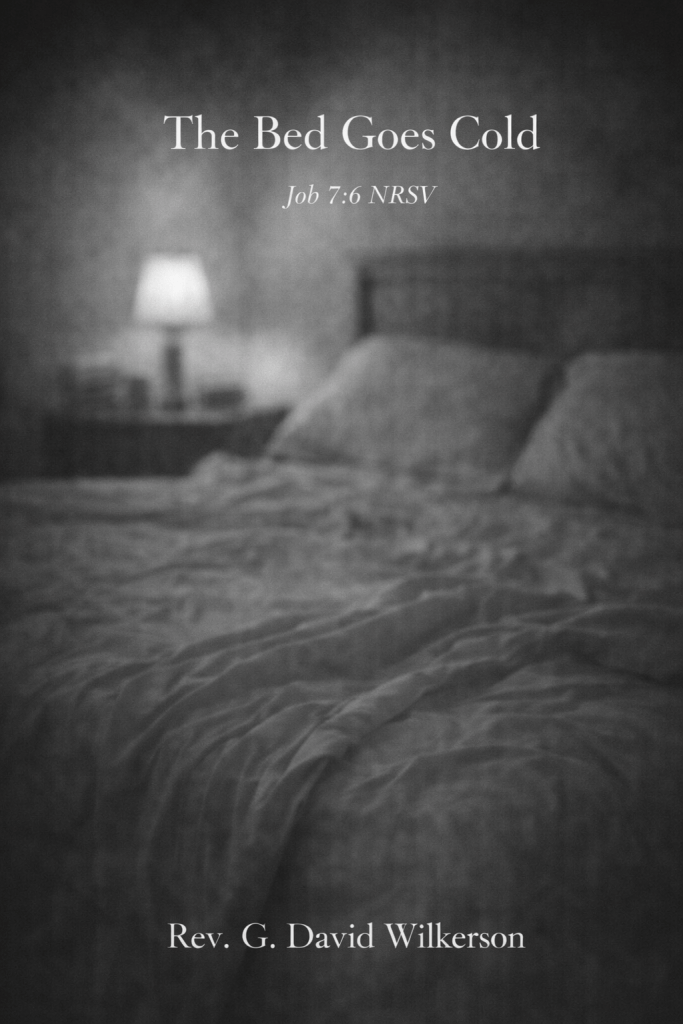
The Bed Goes Cold
Job 7:6 NRSV “My days are swifter than a weaver’s shuttle,
and come to their end without hope.”
It was discovered at night.
One evening the bed was warm with love. The familiar weight beside me. Breath in the dark. The small adjustments two bodies make without thinking.
The next night, the covers on one side remained untouched.
No memory announced itself. No image arrived. This was not recollection. It was discovery. The body noticed the cold where warmth had been and understood something before the mind formed words.
Time did not move forward the way it was supposed to. It folded. The then of yesterday pressed directly into the now of tonight. The difference was not conceptual. It was measurable—in inches, in temperature, in the reach of an arm that met nothing.
Job does not soften this kind of knowing. He does not search for meaning. He marks the speed at which life unravels and leaves the ache intact. The text does not rush to comfort him. It lets the night stand.
I lay there longer than necessary, noticing what was no longer there. The body registering absence as carefully as it had once registered presence.
Some truths are not remembered.
They are re-encountered.
Absence does not stay in the past.
It waits to be discovered again.
Prayer God, stay near when absence feels new all over again.
The Door Ajar
by David Wilkerson
For Beth — whose patience taught me that love waits longer than sorrow lasts.
The maples had gone black behind the drift
and made the clearing seem a larger thing.
I’d meant to walk the fields—a simple shift—
to test how cold a New England noon could bring.
But snow is democratic, hard and bright,
and soon forgot the path I thought I knew.
The sun was dropping low behind the white,
and every landmark vanished from the view.
I only sought the frame where my life stood,
the simple door that kept the cold outside—
a common latch of oak and humble wood,
where I had shelter left, and room to hide.
I scanned the distance for a weathered plank,
some sign a man had built and made things fast,
then saw a portal standing on the bank—
unmortared, yet determined it would last.
It asked no fence and offered no address,
and was too narrow for a barn’s high trade;
but in the heavy, deepening wilderness,
a door is proof that someone once had stayed.
I wondered if the frost had blurred my eye,
or if the wind had opened it and fled,
for here beneath the bleak, encroaching sky,
the heavy pine was slightly pushed ahead.
It was ajar—a crack of golden light—
that promised comfort warmer than the sun.
It did not hold the shadows of the night,
nor ask me what old tasks I’d left undone.
I leaned into the wind, and looked within,
and knew the truth that only time can bring:
the waiting room where journeys must begin,
and every winter proves the final spring.
And in that space where light and shadow met,
a warmth beyond the power of a stove,
there stood the face I never could forget—
the smiling peace of my departed love.
She offered nothing but a patient look,
no shout of warning, and no word of fear;
as calm as pages in a well-read book,
she only waited for my stepping near.
I knew that threshold was no cellar wall,
nor any kitchen where the kettle sings,
but where my wandering ceased, and where the tall
white silence takes the measure of our things.
I will not turn back now to track my prints
into the dark where fading hearths remain.
If I am standing here, it only hints
that soon I’ll see her face beyond the pane.
Then let the blizzard bury where I fell.
I see the welcome offered, clear and plain.
Hello, my dear. I see you waited well.
I only pray my stiffening hand finds
the wood
and pushes.
Outside the Sanctuary
On April 27, 1959, my grandmother Wilkerson died.
I traveled with my parents to a church in Snellville, Georgia. I was not admitted into the building. I remained in the car — a black Ford coupe — parked on gravel beneath open windows.
This was the second death of my childhood. My grandfather Powell had died in July of 1957. I remember more of him. He was sixty-four. She was eighty-six. I was too young to understand death’s permanence, but I felt his absence. I also felt, without language for it, the fracture between him and my mother, and her refusal of affection toward the woman who became his companion after divorce. Even as a child, I sensed something torn.
But my grandmother Wilkerson’s death was different.
It was my first existential crisis.
From the sanctuary, across the gravel parking lot and through the open windows of that black coupe, a hymn drifted toward me:
Rock of Ages, cleft for me,
Let me hide myself in Thee;
Let the water and the blood,
From Thy riven side which flowed,
Be of sin the double cure,
Cleanse me from its guilt and power.
In films, that hymn is often reduced to shorthand for naïveté — a prop for simplistic faith. But it was nothing of the sort to me.
I was a boy sitting outside a church, trying to locate my grandmother inside those words.
Where is she?
And by extension — where is he?
That question has never left me.
Now, more than sixty years later, I sit in church again. It is Lent. Deaths have layered themselves over time, one pressing upon another. Each carries weight.
But there is one whose weight eclipses the rest.
Beth.
Her absence is not historical. It is immediate. It still crushes me.
The boy in the black Ford coupe asked, Where is she? about his grandmother.
The man in the pew asks the same question now.
Where is she?
I weep for her.
And yet, in ways I do not fully understand, I sometimes experience her not as memory alone but as presence. Not as an “It” confined to the past, but as Thou — to borrow Buber’s language — encountered in moments that are unsummoned and enlarging.
I fear wishful thinking. There were long years — decades — of silence. I know what absence feels like. This renewed sense of nearness feels fragile.
But here is what steadies me:
When I sense her presence, I do not become smaller or more withdrawn. I become more loving.
If it were fantasy, I suspect it would narrow me. Instead, it opens me — toward patience, toward tenderness, toward others.
If love reduces the dead to memory alone, then death wins twice.
I am not ready to grant it that victory.
The boy is still listening through open windows.
And even now, I think I hear the hymn.
On Invisibility and Malted Milk Balls
Yesterday I was in a small country store studying chocolate labels like a pharmacist—dark chocolate, no salt—because loving someone long enough means you know exactly what they can and can’t enjoy.
While I was at the counter, the owner, the finest example of a grumpy old man that I know, and I—an apprentice grump—were grumping about feeling invisible.
You reach a certain age and the world doesn’t quite look at you the same way.
Then I glanced at the two women behind the counter and said, “You know who else feels invisible? Women.”
They smiled. Not bitterly. Just knowingly.
And I said, “When you become an old man, you finally learn what it’s like to feel like a woman.”
I gathered my purchases, turned toward the door, and announced to the entire store:
“Wait. Where are my balls?”
Malted milk balls.
Today, on Valentine’s Eve, I’ve discovered a new problem.
I now have to hide my balls from my wife.
Marriage is humbling.
The Middle of Hope
This morning’s worship service caught me off guard.
The reading was Micah, chapter 4—the vision of swords beaten into plowshares, nations unlearning war, people sitting unafraid beneath their own vine and fig tree.
It is a beautiful passage.
Almost too beautiful to trust.
Which may be why it has endured.
As the words were read aloud, an image returned to me—not as memory, but as presence.
It was an image Beth kept close.
A poster she chose.
A prayer she lived with.
At its center: a battlefield grave marker.
A helmet resting on the butt of an inverted carbine, the rifle stabbed into the earth.
Dog tags hanging quietly from the stock.
The sign of a soldier buried where he fell.
Nearby, the words:
Blessed are the peacemakers.
I first saw it in 1972.
I was young, unsettled, and already committed to enter the service of the United States Navy. The war was unpopular. The country was divided. And I was trying to make sense of my own decision to serve.
There were nights when I wondered whether duty and peace could inhabit the same body.
When I first saw the image, I took it as affirmation.
My service was sacrifice.
My sacrifice was a pursuit of peace.
I did not think that belief was naïve.
I still don’t think it was simple.
Years later I realized, Beth chose that image—not as endorsement, but as prayer.
She did not display it to resolve the tension.
She displayed it to live inside it.
This morning, Micah 4 reopened what I once thought settled.
Micah does not offer reassurance.
Micah offers an end that has not yet arrived.
Before plowshares, there is judgment.
Before fig trees, there is disarmament.
Peace, in Micah, is not imagined.
It is adjudicated.
Violence is not denied.
It is named—and then relinquished.
Suddenly, the image Beth loved no longer functioned as approval.
It stood as witness.
The rifle in the ground has not been transformed.
It has only been stopped.
Silence is not the same thing as peace.
Sometimes it is only what remains when the carrier is gone.
The weapon is quiet not because the world has learned peace, but because someone paid the cost before it did.
That realization did not undo Beth’s prayer.
It completed my hearing of it.
Blessed are the peacemakers names the way.
Micah 4 names the end.
The grave marker names the cost in between.
Hope has a middle.
And the middle has graves.
Standing there in worship, grief did not isolate me.
It did not collapse into memory.
It opened into communion—mediated, costly, and real.
Not nostalgia.
Not recollection.
Communion through what she loved.
Communion in the way of seeing she inhabited.
The call that came with it was not loud.
Live this way.
Do not turn aside.
Do not lie about the cost.
But I left accompanied.
 On a whim...