The Uninvited Day
Some days arrive uninvited. They just happen.
Bags are packed—sometimes decades earlier—then stowed away, waiting. Waiting for the uninvited day. When it comes, the bags tumble out of their hiding places, and the contents explode into life.
Yesterday was such a day.
I had an appointment at a medical office dealing with a disease no one wishes to face. It was, in itself, rather matter-of-fact: identify the disease, consider treatment options, make decisions, do my part as a credible member of the team seeking to eradicate the problem.
But then came the baggage.
The baggage carries the awareness of mortality—not so much my own, but of those I’ve loved. Sitting in the doctor’s office, I was reminded again of how many times my late wife must have had similar conversations. Her cycle of remission and relapse always included consultations like this: the tests, the scans, the waiting for results. I was there for much of it.
Those suitcases have been familiar companions for many years.
But yesterday I unpacked another one I didn’t expect: the one I now call Morbid Math.
Morbid Math began when the doctor alluded to my advanced age, as if age alone dictates outlook. Yes, the older we get, the more we must face our finitude. But as I told him, anyone—at any age—can drop dead in a moment. Statistics may predict probability, but statistics don’t govern individuality.
This is where the science of medicine must, if practiced well, meet the art of medicine. Options may narrow with age, but every life still deserves case-by-case care.
And that’s when the arithmetic began.
In just a few years, I will have lived twice as many years as my late wife. That realization stung. I could have done without it. But the uninvited day doesn’t ask permission to unpack what it brings.
Then came another calculation. I remarried thirty-one years ago this past August. Counting the years of our courtship, Beth and I were together twenty-two years—nineteen of them married. The sheer ratio of years makes comparisons absurd. Yet I know this: Beth and I grew up together, and Lucy and I are growing down together. Each love has its own trajectory.
The problem is that growing up was interrupted. And so, I’ve spent the years since trying, in some way, to complete the work Beth and I began. I got to watch our daughters grow up. She did not.
Thank you, Morbid Math, for that reminder.
Two lifetimes, divided unevenly, yet both defining who I am. Beth didn’t just influence me—she created part of me. But she never saw the whole. In that sense, the sum is zero.
She never saw me in my entirety. I robbed her of that.
I know, unequivocally, that she would have. We were on a trajectory toward that kind of honesty. We even talked about the changes we would make to become more fully ourselves—individually and together. But the equation ended before it could balance.
So yes, yesterday was the uninvited day.
One of the worst I’ve had since the day she died.
But even this arithmetic of loss holds its strange grace: that who I have finally become—the man willing to be raw and vulnerable—is the collaborative work of two women who loved me into wholeness.
Beth began the work. Lucy has helped me finish it.
*I cannot change the sums, but I can live them. And perhaps that, in the end, is
Tears in Writing
Sometimes the tears that come while writing aren’t grief at all, but love finding its way to the surface.
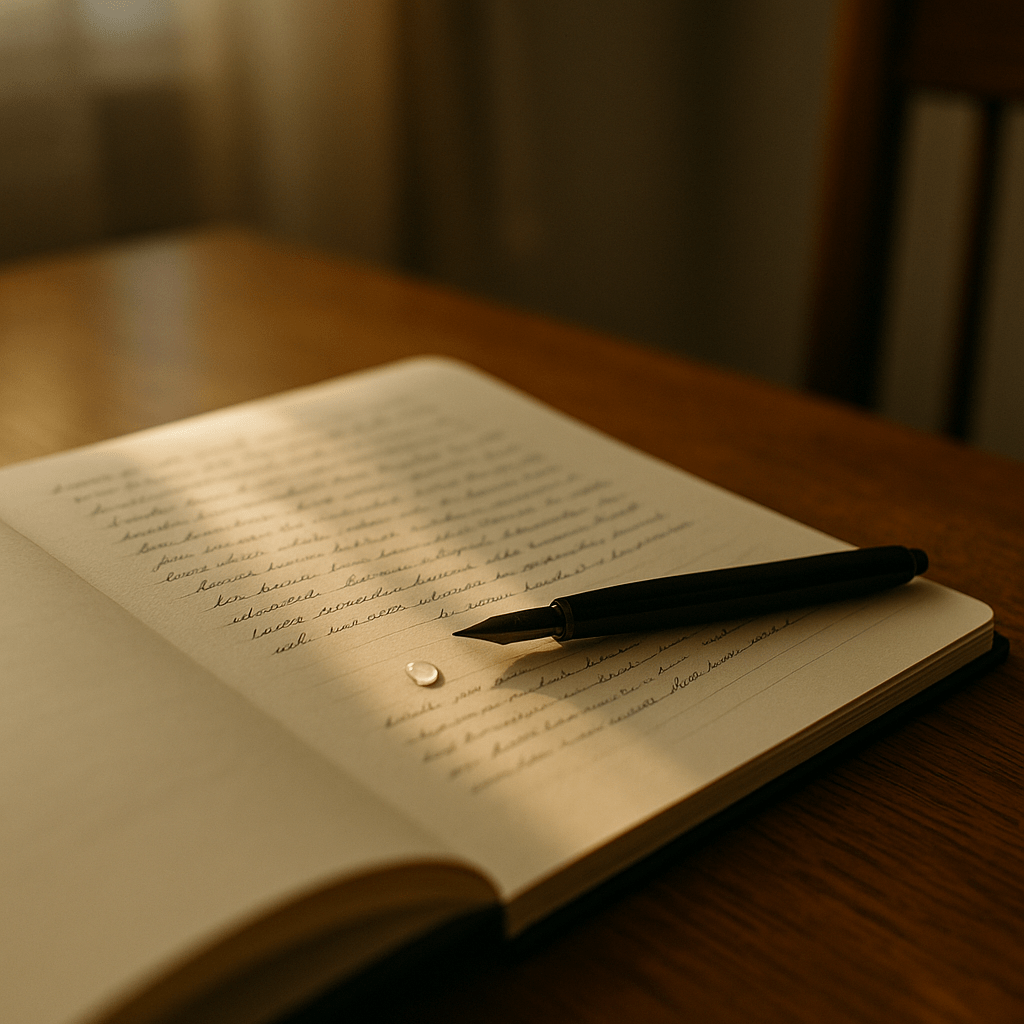
When the Tears Come
Every so often, while rereading a passage I’ve just written, I find myself suddenly and unexpectedly weeping. The pressure behind my eyes, the burn in my throat, even the ache in the roof of my mouth — it all gathers and releases at once.
I’ve learned not to resist it. These are good tears. They are proof that the story is still alive in me — the same story I carried for decades in silence, now finally being allowed to breathe again.
To weep while writing is not to observe grief from a distance; it is to live in a state of love. The emotion rises, moves through me, and then quiets. When it does, I can keep going — not because the pain is gone, but because the love remains.
I believe that’s what any honest book asks of its author: not detachment, but presence. To feel it all. To let the tears bear witness that what’s being written is still alive, still human.
And when the page is dry again, I know the story I’m telling isn’t meant for me alone. It’s for anyone who has known love, or longs to know it — anyone who has embraced, or endured, its loss.
— D.W.
The Little Death
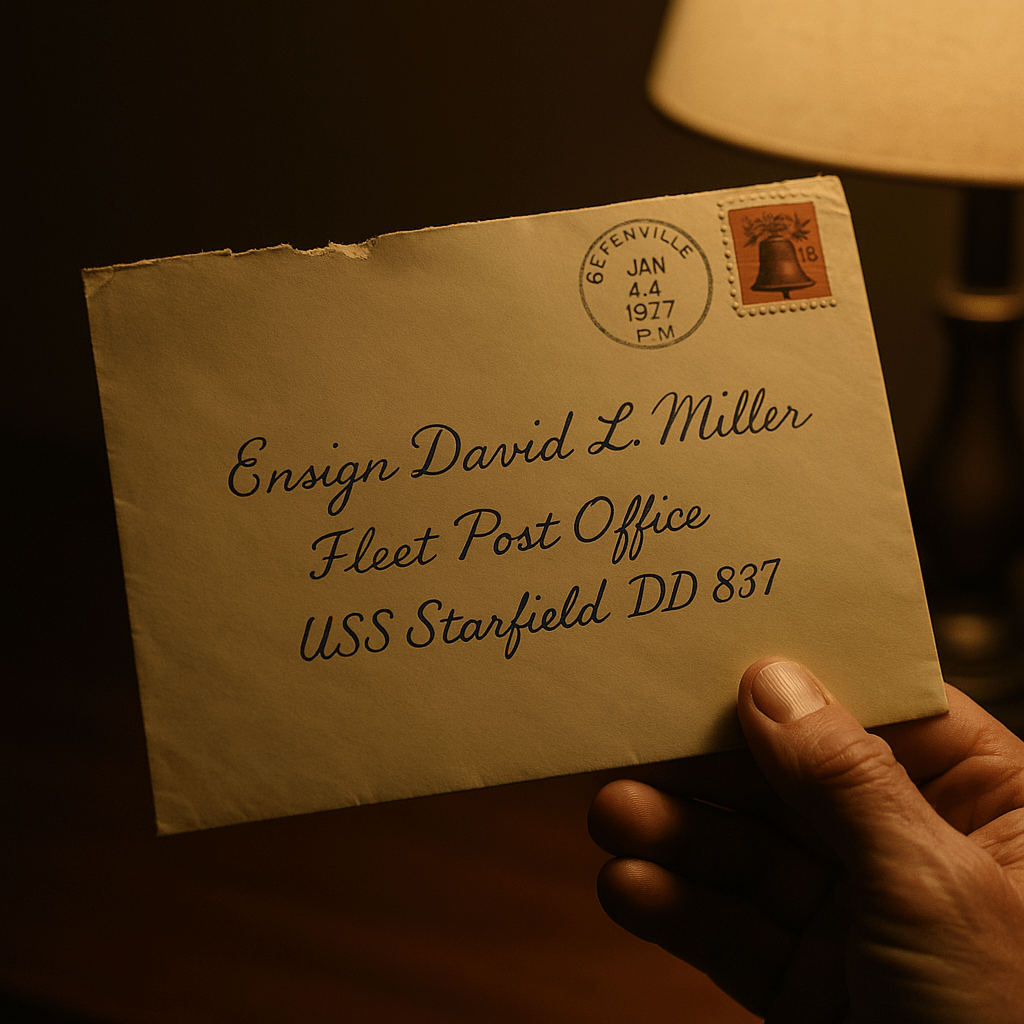
I pick up the envelope — only slightly yellowed by time. The end is torn open, as if in great haste to read what it once held. I lift it to my face, hoping for some trace of her scent, some faint whisper of the hand that sealed it.
Emotion rises; her absence floods me. My eyes follow each line of the address — her capital E in “Ensign,” the luminous D she always gave my name. Every letter is carefully inscribed: Fleet Post Office, USS Starfield DD-837.
I squint to read the postmark, my vision not what it once was. Beneath the lamplight I finally make it out: Greenville, P.M., 14 January 1977.
This was the letter she sent after her solitary journey across Europe — that audacious pursuit of adventure, and of me. I have read it countless times and never had enough. Again I’m struck by the cruel truth: there will be no more letters.
Even now — fifty years since our wedding, thirty-two since her death — the sweetness of her words undoes me. It is la petite mort in its truest sense: the tender collapse of what once was flesh and is now only memory.
I close my eyes and let it take me. The ache, the sweetness, the loss — all of it. For one breath, I hold her again. And though it breaks me, it sustains me.
— D.
🎵 The Problem with Regret
I have hung my harp upon the years, yet in every wind that passes, I hear her name.
- from the journals of exile
“By the rivers of Babylon, there we sat down and wept;
we hung our harps upon the willows.”
— Psalm 137 : 1-2
I.
By the waters of memory, I sat down and wept,
And hung my harp on the limb of the years.
The wind in the reeds made a sound like forgiveness,
But it wasn’t forgiveness I heard — it was fear.
II.
Regret is a carrion bird, circling slow,
Feeding on grief that refuses to die.
Its shadow falls long over everything holy,
And whispers, you could have loved better than I.
III.
It never flies lonely — recrimination comes near,
A beast in the dark with a tongue made of blame.
They feast on the bones of what memory offers,
And leave me the echo, the ache, and the name.
Refrain
It wasn’t the box but the silence that fed them,
The years I mistook for the comfort of peace.
Now I open my hands and the feathers fall upward —
They vanish like breath, but the hunger won’t cease.
IV.
I walk through the hush where her laughter once stood,
Through the door that no heartbeat will open again.
And I hear from the willow the faintest of music —
A string half-broken still answering pain.
Coda
By the waters of memory, I sat down and wept,
And hung my harp on the limb of the years.
The song that I lost is the one that still finds me,
And silence itself is the sound that I fear.

The Problem with Regret
(from Random Musings)
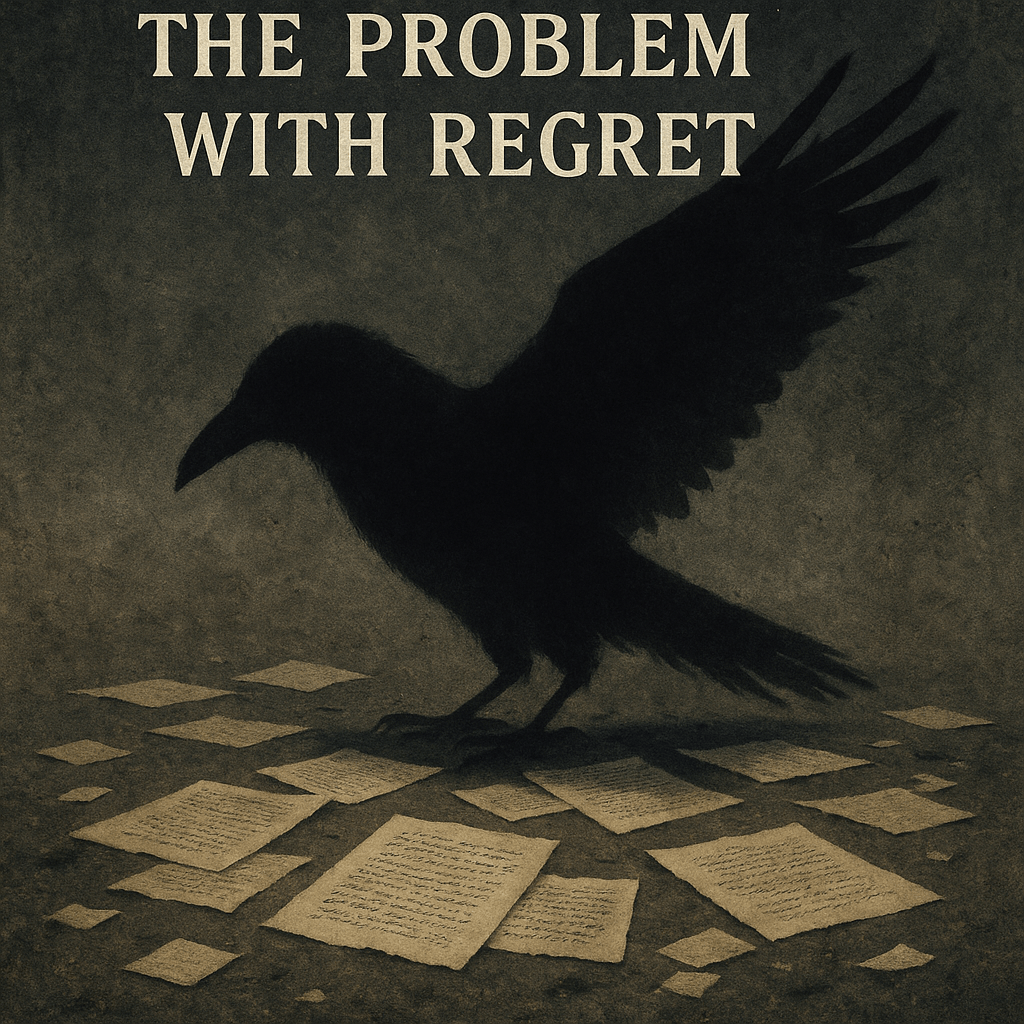
Regret is a carrion bird.
It feeds on the grief of those who have loved and lost.
It seldom flies alone.
Its companion is another scavenger beast — recrimination.
As I walk the corridors of memory, both bitter and sweet,
I feel the air stir with their wings.
They circle close, patient and hungry.
I tell myself I am learning —
how I might have been a better man,
a better husband,
a better soul who held nothing back
from the one who withheld nothing from me.
But what I discover instead is a new sorrow.
It is regret itself —
made of things not done, not said,
and of the hurtful words once spoken.
Together they feast upon the bones of memory,
tearing at what flesh remains
until scarcely a heartbeat is left behind.
They shred the heart and leave the mind exhausted.
And I cry out, no more — let me remember no more.
For a moment I reach for the box
that has kept my memories safe these many years,
and begin to put them back,
thinking I might rest if I forget.
But then I remember:
it was not the box that fed these beasts,
but the silence.
And to return to silence
would only feed them again.
 On a whim...