FRIENDSHIP
Why did the Scout bring a ladder to his friends’ campout?
Because he heard friendship was on a whole new level!
Ever have a friend who can lift your spirits even when their own sky is overcast? The kind who seems to carry a little lantern of light just bright enough for two?
Lately, I’ve been thinking about the Scout Law—“A Scout is helpful, a Scout is kind.” Those two alone could heal half the world if we’d let them. Kindness and helpfulness are the tools by which we raise the human spirit.
Not long ago, when life felt heavy and uncertain, a few friends reached out. One offered quiet words of care, another offered practical help—“anything, even the silly household chores.” Somehow that kind of specificity opened a door in my heart. It made it easier to imagine saying yes to help when I needed it.
It reminded me that when we offer to help, it’s not the size of the gesture that matters, but its shape—those small, concrete acts that whisper, “I see you.”
I’ve tried to live that way myself. Bringing a meal, lending a hand, hauling a load, or simply showing up. Not heroic, just human. Little things that make life gentler for someone else.
So that’s my musing today: Find a way—any way—to lift someone’s spirit. Do a small thing that makes a big difference.
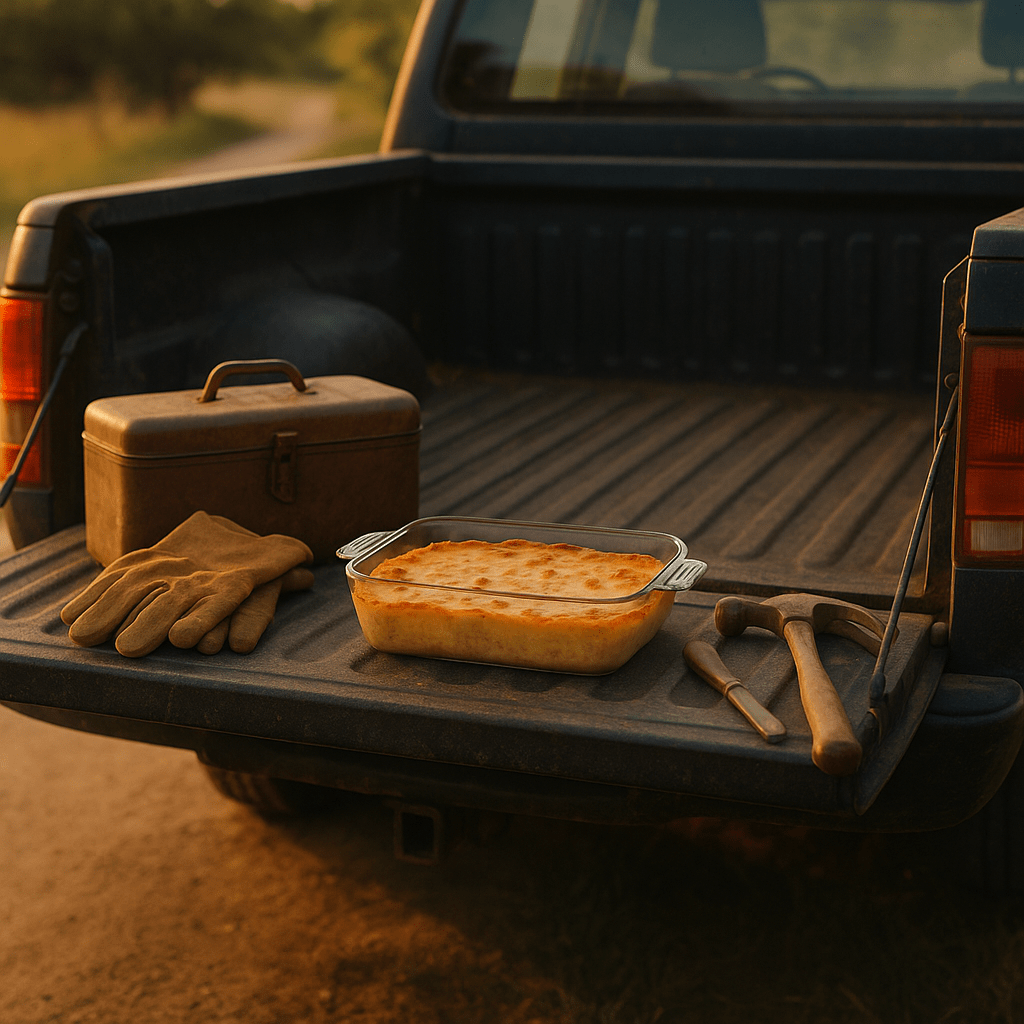
Because in the end, friendship might just be God’s way of reminding us that chores and grace often travel in the same truck bed. 🚚
Time Travel
On the strange elasticity of years and the tenderness of realizing how swiftly they pass.
⸻
A child sits on the floor, lost among his toys.
His mother says, It’s time to go now. Put them away.
In his imagination he is already moving—
tidying, obeying, swift as thought.
But to her eyes nothing has changed.
Seconds pass. The command comes again, sharper this time.
And when she scolds him for not listening,
he is bewildered.
How could she not see?
He had begun the instant she asked.
A child does not measure time.
He lives inside it like a fish in water,
the current invisible, infinite.
An adult measures it out—seconds, minutes, hours—
a metronome against which patience ticks and love frays.
Between them lies not disobedience,
but two different kinds of existence.
And then, one day, the parent grows older.
The tempo steadies, then slips.
Days become weeks, weeks turn to months.
The seasons collapse into one another
like pages turning too quickly to read.
He watches grandchildren at play
and says the thing the young never believe:
Enjoy this while you can. These days will be gone before you know it.
For this too is a kind of time travel—
to stand in one moment and remember another,
to scold the child you once were,
and to hear yourself answer back
from somewhere deep in the years.
And when at last you understand
how swiftly it all has gone,
you smile—
not for joy exactly,
but for the tenderness of knowing
you were there,
and it was enough.
⸻
Reflection:
We never meant to become travelers in time; it happened while we were looking away. Yet somehow love leaves footprints in both directions, marking where we stood when it still felt like forever.
⸻

Where All Waters Join
Sometimes grief does not cry out—it drifts, carried by the same current that once bore our joy.
There are moments when loss comes not as thunder but as reflection—when the world stands still, and what we see is not the end but a continuation, changed in form.
I wrote this after a dream of a river and a face that was both Ophelia’s and hers—the one I loved more than life itself.
It is not about death, not really. It’s about arrival: the mystery of the one who was, the one who is, and the one who has yet to come.
I offer it here in gratitude and quiet wonder, a meditation on how love endures beyond the reach of hands.
⸻
I see Ophelia floating, dreamlike,
on the current of a cold river.
The water moves with a whispering insistence,
brushing against stones polished by centuries of sorrow.
Her body is already still,
her face molded by the mercy of the chill
into a child’s perpetual smile.
Then the surface wavers,
and I recognize the curve of her mouth—
not Shakespeare’s daughter of grief,
but the woman I loved more than life itself.
The recognition is the wound.
Not that she is gone,
but that I can no longer feel the warmth
that once made her real.
The ache lives in my hands,
in what they remember
and the water refuses to return.
Yet even as I kneel on the bank,
a strange peace rises.
The river does not end;
it only carries her beyond my reach.
In its mirrored flow I see three arrivals:
the one who was — radiant and laughing in sunlight;
the one who is — still, luminous, beyond decay;
and the one who is yet to come —
the presence that will meet me when my own current slows.
I do not call it faith,
only recognition —
that love does not vanish;
it merely changes address.
The current carries her onward,
and somewhere downstream,
in water not yet visible,
I believe she waits —
not to return,
but to receive.
⸻
And so I let the river keep her, trusting that love, like water, knows its way home.

A lyrical reflection on loss and arrival. Through the image of a woman floating on a twilight river, “Where All Waters Join” explores how love endures beyond separation, and how grief, carried by the current, can become peace.
Lover’s Tryst
Sometimes love begins with absurd devotion — a sink bath, a borrowed car, and a hymn you can still hear a lifetime later.
He shaved in the passenger seat while the car hurtled south, the morning sun strobing through the pines. Each time the blade clogged, he tapped it on the paper cup between his knees and said, hit the washer, and the driver obligingly flicked the wipers so a fan of water arced across the glass. He leaned out the window, rinsed the razor in that brief baptism, and drew it down his jaw again. By the time they crossed the county line, he was half raw, half radiant, the scent of McDonald’s soap still ghosting his hands.
He was twenty, maybe, and in love, real love, for the first and only time with the kind of trembling certainty that makes a person do foolish, holy things. He had not confessed it to her yet — not in so many words — that she was the center of his orbit, the reason he was trying to be better than he knew how. He feared that naming it might break the spell, might make her step back and see him as the overeager boy he really was. So he said nothing. Instead, he “hijacked” a friend and his car, skipped breakfast at the retreat center near Tryon, and drove two hours to surprise her at church.
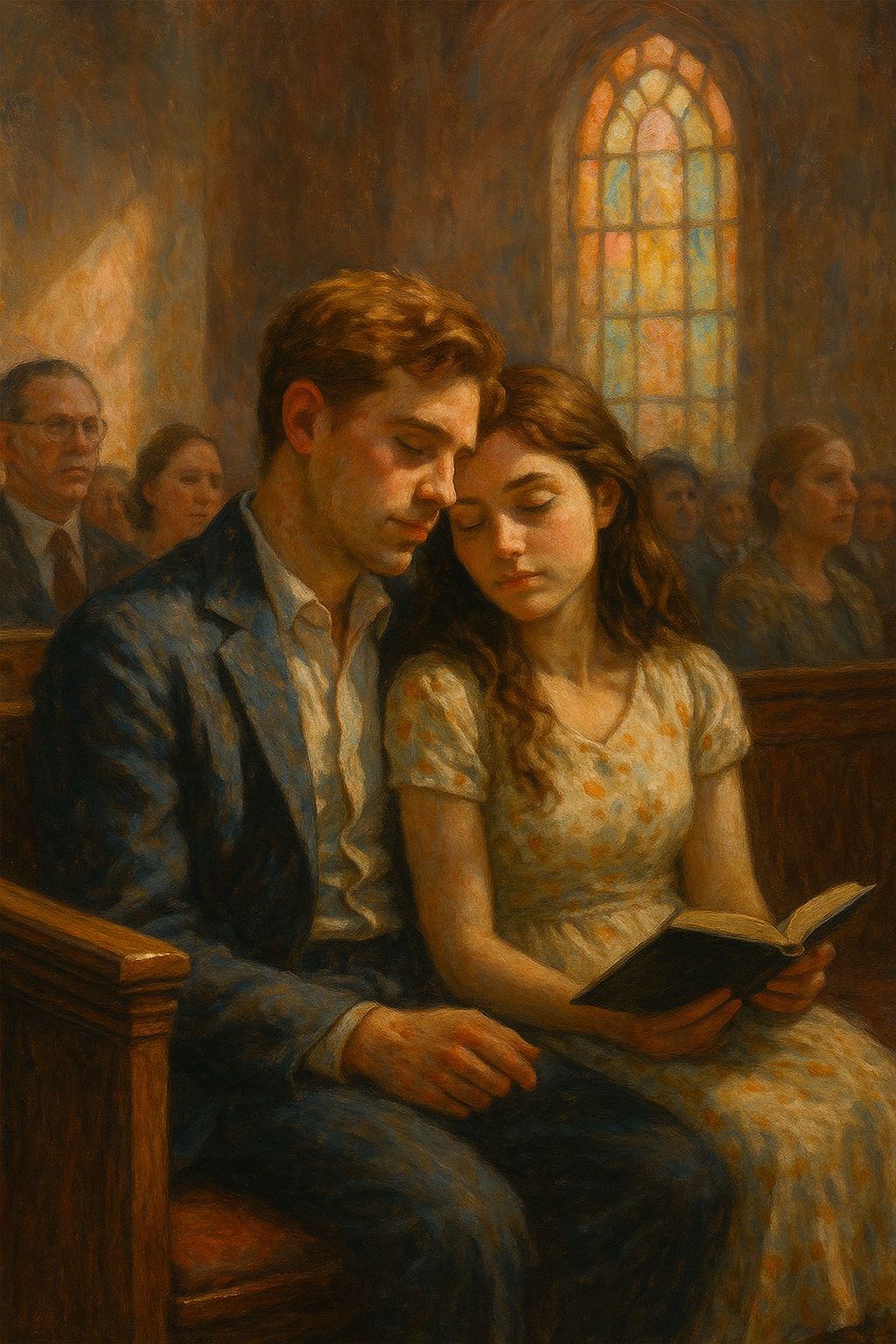
When he entered the sanctuary, the air was already thick with hymnals and perfume. He spotted her three pews from the front, adjacent to her parents whose posture could have been sculpted from caution itself. She saw him and smiled — not the demure, social smile of a preacher’s daughter but something that started in the eyes and made its way outward, slow and unmistakable. He slid into the pew beside her family and inched as close as courtesy allowed. Closer, maybe. The heat from her shoulder seemed to vibrate through him, a silent current he could neither escape nor complete.
Their bodies had known enough of each other by then to make nearness dangerous. They had kissed until the edges blurred, learned the shape of patience and the ache that lived inside it. They had stopped short of everything they could have done, which made everything they did do shimmer with unsustainable light. He told himself restraint was virtue, but it felt more like fever.
When the congregation stood to sing, he sang too, but softly, waiting for her voice. It came faintly — a whisper meant for God alone — and he lowered his own to meet it. For a breathless instant her voice was singled out in his ears. Then their tones mingled in the air, his rough, hers barely audible, a harmony no one else could hear. That single note of hers, shared and gone, would outlast the rest of the service, outlast the years, outlast her life.
Afterward, under her parents’ watchful eyes, there was no touch, no private word, just a shy exchange of glances that said everything: I see you. I feel you here beside me. Later, when he tried to describe it, he would call it a kind of communion — the first time he understood that desire and worship might spring from the same well. The body, after all, is only another way of praying.
Driving home, his face still stung from the shave and from the effort of holding himself together. The wipers squeaked once more across the windshield, and he laughed — at the absurdity of it all, the romance, the restraint, the way love could make even a windshield washer into holy water. He had risked the ridicule of friends, the suspicion of her parents, and the razor burn of devotion, all for the chance to sit near her and hear that small, trembling hymn.
Decades later, he would remember none of the sermon, only the scent of soap, the gleam of her hair in the filtered light, and that one pure thread of sound rising like a prayer. The note itself had long vanished into silence, but somewhere in him it was still vibrating, proof that what begins in a whisper can last a lifetime.
Finding Our Route
How did the tree get lost in the woods?
He couldn’t find his route.
We may not be trees, but we spend a lot of time searching for a way forward. Sometimes the best choice is simply to pick a direction and start moving. Other times, when we’re truly lost, the wiser course is to stop, sit down, and take stock.
That’s the trouble with life: for almost every situation, there’s more than one plausible answer. Knowledge alone doesn’t always point the way. We need wisdom.
But what is wisdom? I believe it grows out of knowledge and experience together. Yet sometimes it comes as more than the sum of those parts. Sometimes Providence stirs the pot, and God lays a finger in the pudding. And when He does, a path we never imagined clears before us—one that leads not to despair, but to surprising and blessed results.

 On a whim...