Boredom Is Not a Birth Defect… It Could Be Congenital, Though…
Not too long ago I listened to an interview with James Taylor and he attributed his creativity to boredom. I guess I haven’t been bored enough for a while now? Today to add a new post to my blog I am leaning on the extraordinary creativity of a friend whose effort to invite a date to the school prom suggests that he is must suffer from congenital boredom (if Mr. Taylor is correct). PLEASE watch this:
For shame….

Thanks to The Christian Gift for a great shot.
The maple I see from my window is clearly embarrassed by the pending nudity of limbs and branches. She is blushing. It must seem odd to her, having nurtured the tree since spring, to now abandon her perch and leave the tree free from her calming presence. If only she could know nor’ easters to come are the sum of the great northern forests’ wiggly flaunting their bare selves. Oh to sing the coming stirring air and let our pale yellow blush burn with brightest passionate red!
To Die (to Write), to Sleep, to Sleep Perchance to Dream…
 There is some aspect of death in the act of writing that rises in the instant of losing oneself in narrative. We writers are permitted to dream. But what dreams indeed may come? I am told that for some, writing is like a narcotic. The dictum, “You are a writer if you are compelled to write,” has been hammered into me for decades. Real writers are addicted to their narratives?!
Not me. I have always wanted to write and write well. But, in a perverse self destructive effort to prove I am not addicted, ergo not a writer I seek refuge in the mundane. How I love the distraction of a clogged toilet and cherish the joy of a late night return to the house and finding doggy hors d’oeuvres scattered from den door to garbage can.
I used to write a weekly newsletter column. One that I pompously titled “In the First Place”. Every day would start with random scribbles with the idea that I would build momentum as the deadline approached. Starting with some superfluous worlds and adding more of the same I would finally have whole paragraphs of noise. These I gleefully discarded knowing that NO ONE wanted to read my blathering nonsense. Far better that I tighten screws on a door handle, dust a window sill, and repeatedly check whether the wadded paper in the bin had enough relatives to constitute a zoning violation so I could toss out the whole lot.
But who am I kidding? What else pulls me to a keyboard late at night or forces a pen and church bulletin into my hands during prayers? What other form of insanity compels me claw through an in-flight magazine searching for a clear margin on which to scribble random thoughts and waking dreams.
It is a sad thing to believe a writer is always a Jack Kerouac, drawn by the call of a great idea to sit for hours or days birthing an idea in a single gushing stream of consciousness. There are times when I wish I could not sleep. Times when I wish my own compulsion to write was easier for me.
In my Walter Mitty life as a writer, I see myself awakened from a dream filled sleep. Flailing, groping for a lighted pen and note paper (real writers have cool tools) I record passages of sublime prose. The real me is awakened by the familiar urge of a full bladder. I stumble down the hall and I reach the toilet to find it is clogged… again. In my groggy state the only narrative is a rich and unrecorded internal discourse regarding how gross is the state of the toilet.
When it comes to writing there’s no easy way out for me. I am compelled to tell the stories in which I find, rather than lose, myself. To find myself in a narrative flow I have to plunge into a reality filled with loose door knobs, clogged toilets, and raucous hounds that feel ever so free to help themselves to the dainty treats in the garbage can. To be and to write in the world filled with be-ing, or not to be is the question indeed.
Out of Little ‘Cwacks’ What Mighty ‘Things’ May Come?
Children inspire me:
Child: Mama, there’s a cwack in the ceiling.
Mom: It’s ok. Sometimes houses have little cracks.
Child: I think it’s gonna hatch soon.

Courtesy Kellene Bishop, Preparedness Professional on preserving eggs.
A robust deconstruction of the exchange is revealing. First the child made a public service announcement about a “cwack”. Nothing critical just an FYI to the powers-that-be commonly known as Mom or Dad.
Mom replies with an enthusiastic downplay of the reported issue. “Nothing to see here. Move along. Don’t worry about it.” In kid-speak this means that there’s more here than meets the eye and the powers-that-be don’t want you to get yourself all riled up about it. The consequence is that there’s more to investigate or at least to speculate.
What could this “cwack” mean. Now, maybe, if the kid in question spent too much time in front of Fox news she would immediately consider that the earth’s crust had ruptured and whole hectares of the metropolis were being consumed by hot lava. (I know this can happen because for a whole year my kid drew pictures with hot lava coming from everywhere: the tub drain, the garden hose, the unseen pit beneath the dentist’s chair, etc.)
Not so with this kid, this one lives in the land of butterflies, chicks, and kittens (for now) and she has a simple explanation. “It’s gonna hatch soon!”
Now, if only someone had asked what was going to climb out of THAT shell?
The Devil and the Deep Blue Sea

Wooden Boat magazine.
Once, seduced by a picture in a magazine, I built a boat. I was omniscient, a teenager, and I knew I could build “a salty little pram small enough for a ten year old to handle.” I didn’t have a clue about boat design, construction, or the basics of sailing. But heck, neither did Noah! Furthermore, I was a hardened veteran of Mr. Henderson’s woodworking class. In my mind, when it came to ‘making things’, I was a natural.
I had a portfolio of success: a doll sized cradle using nothing but a hand saw, brace and bit, and sweat (and I thought the lopsidedness lent it more credibility as a ‘hand crafted’ treasure), a mahogany three tier table with cabriole legs straight out of the pages of Popular Woodworking with a distinct Italian flair (it leaned a bit), a dog house (that lacked charm) and I built it with a hack saw even after lopping of the knuckle of one thumb. I was persistent! Couldn’t I fell the timber, chew off the bark with my bare teeth , wrestle iron ore from a nearby mountain, and forge nails in my parent’s central heating system… ?
I was a frugal teen (meaning, I had limited funds earned by mowing lawns) so I sought out adequate lumber for the project. What’s wrong with wood gleaned from old pallets? Why not use cheap plywood than the one called for even if its been stamped with the word “INTERIOR”?
I fought with plywood and warped pine skewering them together with pound after pound of brass screws. (Every dollar I saved on lumber was lost in the pounds upon pounds of brass screws.)
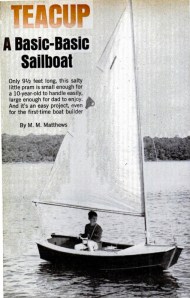
Popular Mechanics online archive at Google Books
Speaking of brass screws, have you ever held a 1 gross box of them? Astonishing! Ultimately the ‘my lady’, as I liked to call the boat, was a beast whose weight was overwhelming. Unlike some big boned people I know, this clunky dingy lacked grace. The only thing salty about that boat were the gallons of sweat that soaked into her timbers.
I wish I knew what it was that made me persist with the effort to build the boat. Probably the same thing that made me insist to my fourth grade teacher that my pet duck really really ate my home work. Or, more likely, I was still looking at the picture I imagined it to be and not the able to see it for what it was. So I held on to the vision of it as a creature only needing water to transform it, mermaid like, into an elegant creature.
Some months after I began to build the ark, I persuaded Charles, my skeptical neighbor, to help me launch it. We hauled the glorified transoceanic-shipping-crate on top of his 1966 Carmen Ghia Coupe. It only goes to show how marvelously engineered those cars were; Figuring the boat weighed close to three hundred pounds the roof of the glorified bug did show a single bruise! Of course I have no idea why shortly afterward he had to have his clutch replaced.
Driving north of Atlanta, we found a thankfully deserted Corps of Engineers boat launch on Lake Lanier. Marvelous to my eyes were the white caps breaking all across the lake. It was as if the forces of nature wished me a bon voyage worthy of Joshua Slocum.
Just in case you don’t know, Slocum was an early 20th adventurer and sailor who is apparently the first person to sail solo around the world.
In any case, I shoved off. Charles remained on shore to, as he put it, take pictures of me in the boat. More likely he knew better than to board the thing with me having witnessed me stuffing rags into several conspicuous leaks around the keel. I unfurled the sail, hauled in the sheet (that’s a rope for you land lubbers), and pointed the bow down wind.
Away I went… really away and fast. I was at least 1/4 mile from the launch point when I thought I should ‘come about’ and ‘wear ship’ (I learned the terms from the tales of C.S. Forrester about “Horatio Hornblower” and had no clue that ‘wear ship’ was applied to square rigged ships. What I did know is that I had to turn around and try to work my way back toward shore. Today I would say I needed to come about and make a series of tacks to windward. Back then I think, as I tried to just this, all capacity for speech ceased, froze, and sentient thought yielded to one terrifying certainty, this boat would never ‘tack’. It was more like a paper cup. Albeit a very heavy cup. The wind remorselessly tossed us across the lake.
Lanier is a large artificial reservoir. Given the severity of the wind and the increasing roughness of the water it was doubtful that the boat, or I, would survive long enough to make it all the way across.
While I was doing a remarkable job of looking and acting like a panic stricken fool I saw that a small island (a pile of rock with a few pines) might actually be reachable. I prayed with great devotion unrivaled by any but the most desperate mariners. I also promised that I would never ever again do whatever it was that my teenage mind thought would please the Almighty and then, for good measure, tossed up the idea that I would even go so far as to do the Almighty whatever favor might be pleasing.
More grateful than Robinson Crusoe and luckier than Joshua Slocum (he and his boat were lost at sea and never seen again) I made it to the island. From there I dragged the boat around to a point near the opposite shore from which I had started. The water being shallow, the sail and mast having a bit earlier been ripped from the boat by the wind (and a little help from me), I waded across and summarily hauled the ‘boat’ home.
Seduction is a dangerous thing. It can delude one into thinking something that never was, never will be, or simply can’t be is there for the taking. The sad thing is that in my case the seduction was self imposed and that, probably, is the worst kind of all. I learned a lesson that day. Always, always be sure to use better wood.
 On a whim...